The new Westhill High School delivers an energy-efficient facility that improves traffic circulation, enhances the educational environment, and supports the surrounding community. Site features include two synthetic-turf fields, a natural-grass baseball field, a softball field, and tennis courts. The existing high school, which will be occupied during construction, will be demolished upon completion of the new building.
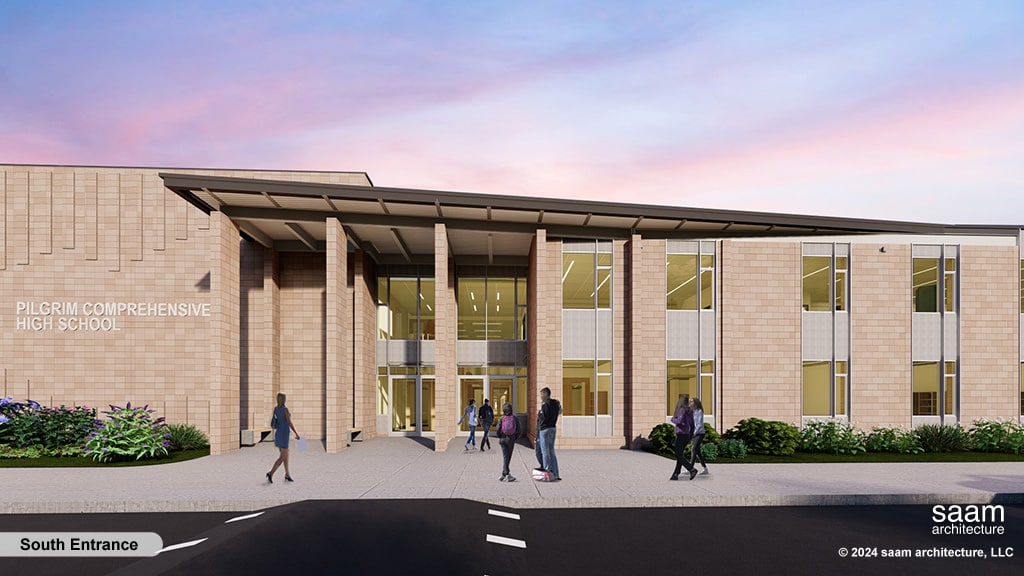
Pilgrim High School is designed to support 21st-century learning and reflect the District’s goals for an equitable, flexible, and community-centered facility. Classrooms are organized within non-departmentalized learning communities, encouraging cross-curricular collaboration by integrating Career and Technical Education, vocational and technical programs, health, arts, and core academics.
Large common spaces, including a double-height dining and learning commons, serve as the building’s central spine, connecting students across activities and providing clear wayfinding throughout. Simplified and standardized materials support long-term sustainability and reduce maintenance costs.
Toll Gate High School is designed around modern learning and community connection. The school includes classrooms, labs, learning studios, CTE workshops, and student commons, as well as a gymnasium, an auditorium, a dining commons, and a media center. Key shared spaces were designed with the broader community in mind, creating opportunities for engagement beyond the school day.
Kizirian PK-8 School is a purpose-built facility replacing the former elementary school on the same grounds. The building is designed to serve students across pre-kindergarten through eighth grade, with three classrooms per grade. Accessible and inclusive by design, the facility includes separate bathrooms and learning areas for the youngest and oldest students, as well as updated technology and safety features throughout.
The Garden City Elementary School project included demolishing the existing building and constructing a new facility designed by Fielding International. The school accommodates 575 students in grades K-5 and incorporates modern 21st-century learning standards.
Site improvements feature bus and parent drop-off zones, expanded parking, new play structures, outdoor learning areas, and landscaping. The building includes a cafeteria, gymnasium, and flexible performance spaces supporting educational and community functions.
Delivered through a joint venture with Fontaine Bros., the new Doherty Memorial High School supports 1,670 students in a modern, future-ready environment for grades 9–12. The facility features a theater, an 800-seat auditorium, and a large gymnasium that anchors the school’s athletic offerings.
Academic programs integrate vocational-technical courses such as programming, web development, construction craft laborer training, and Advanced Academies in Biotechnology and Special Education. Chapter 74 Vocational spaces, computer science classrooms, science labs, and STEM makerspaces are designed to support hands-on, interdisciplinary learning.
The existing high school, built in 1966 on a 20-acre parcel, remained operational during the phased construction of the new facility on an adjacent site. Upon completion, the original building was demolished to make way for new athletic fields.
The project followed the Green Worcester Plan to support the city’s goal to achieve net-zero carbon emissions by 2050. Sustainable elements include 1,776 high-efficiency rooftop Vortex solar panels to reduce energy use and operating costs.
The Early Childhood Building at Meeting Street expands the campus with a well-designed two-story facility featuring classrooms for infants through preschool, faculty offices, and adaptable training and conference spaces.
Renovations to the existing Early Childhood Center and Early Intervention areas support program growth by adding music and art classrooms and new pre-K spaces. This project strengthens Meeting Street’s commitment to delivering a dynamic and engaging educational environment.
The school includes a three-story High School wing that houses typical and specialized High School learning areas and High School administration; it also includes a three-story Middle School wing that houses Middle School administration and typical and specialized Middle School learning areas arranged in teams. This configuration allows for two teams per grade and one grade per floor, a spine concourse, and the one-, two-, and three-story “core plus” wing, which houses shared spaces for athletics, the arts, the cafeteria, and the media center. BIM was used to spatially coordinate MEP/FP systems to improve installation and reduce rework.
Designed around a flexible pod-based academic plan, the school organizes classrooms around shared spaces that support a range of teaching and learning activities, including large-group instruction, technology, and media. The project was constructed on an occupied campus, requiring careful phasing and coordination to maintain school operations throughout construction.
The Jonathan E. Reed School features a two-story classroom wing with dedicated rooms for each grade, special education, art and science, and home resource classrooms. This wing also includes a media center and staff support spaces. An adjacent wing houses a full-size gymnasium, athletic support areas, and a two-story open-ceiling cafetorium.
The City of Waterbury received over 90 percent reimbursement from the State of Connecticut and ensured compliance with the Office of School Construction Grants & Review (OSCG&R) documentation requirements throughout the project. The school’s completion has provided significant social and economic benefits, generating pride and excitement in the surrounding community.